Quando il conduttore non è un filo ma una massa estesa, le correnti indotte si chiudono in vortici dentro il materiale: sono le correnti parassite o di Foucault. La loro dissipazione per effetto Joule è a volte sfruttata (freni, levitazione, cottura a induzione), a volte combattuta (nuclei di trasformatori e motori).
When the conductor is not a wire but an extended mass, the induced currents close into vortices inside the material: these are the eddy currents, or Foucault currents. Their dissipation through Joule heating is sometimes exploited (brakes, levitation, induction cooking), sometimes fought against (transformer and motor cores).
Quando il conduttore non è un filo ma una massa estesa (un disco, una piastra, un cilindro), le correnti indotte non sono costrette in un percorso unico: si chiudono in vortici dentro il materiale, formando le correnti parassite o correnti di Foucault (dal fisico francese Léon Foucault, che le studiò nel 1855).
Principio — Correnti di Foucault
In un conduttore esteso sottoposto a un campo magnetico variabile (o in moto relativo rispetto a un campo) si stabiliscono correnti indotte a forma di anelli chiusi dentro la massa stessa. La loro potenza dissipata per effetto Joule è proporzionale a:
- il quadrato della frequenza di variazione del flusso,
- il quadrato dell’ampiezza di ,
- lo spessore (al quadrato per piastre sottili) del conduttore,
- la conducibilità elettrica del materiale.
Vale la pena chiarire i nomi: “Foucault” e “Lenz” indicano lo stesso fenomeno visto da due lati. Le correnti sono nominate di Foucault; la legge che spiega il loro verso — sempre opposto alla variazione — è quella di Lenz.
Queste quattro dipendenze spiegano tutte le applicazioni pratiche: si aumentano frequenza, campo, spessore e conducibilità quando si vuole dissipare (freni, cottura), e si spezzano i percorsi delle correnti (lamierini, fessure) quando la dissipazione è indesiderata.
Collegamenti
Argomenti: Induzione elettromagnetica Concetti: Correnti di Foucault · Effetto Joule
Esercizi collegati: Problema — La calamita nel tubo di rame · Esercizio svolto — magnete in tubo, velocità limite · Esercizio svolto — disco di Waltenhofen
When the conductor is not a wire but an extended mass (a disc, a plate, a cylinder), the induced currents are not confined to a single path: they close into vortices inside the material, forming eddy currents or Foucault currents (after the French physicist Léon Foucault, who studied them in 1855).
Principle — Eddy currents
In an extended conductor subjected to a varying magnetic field (or moving relative to a field), induced currents form as closed loops within the mass itself. The power they dissipate through Joule heating is proportional to:
- the square of the frequency of the flux variation,
- the square of the amplitude of ,
- the thickness (squared, for thin plates) of the conductor,
- the electrical conductivity of the material.
It is worth clarifying the names: “Foucault” and “Lenz” denote the same phenomenon seen from two sides. The currents are named after Foucault; the law that explains their direction — always opposing the change — is Lenz’s law.
These four dependencies explain all the practical applications: frequency, field, thickness and conductivity are increased when one wants to dissipate energy (brakes, cooking), and the current paths are broken up (laminations, slots) when the dissipation is unwanted.
Links
Topics: Electromagnetic induction Concepts: Eddy currents · Joule heating
Related exercises: Problem — The magnet in the copper tube · Worked exercise — magnet in a tube, terminal velocity · Worked exercise — Waltenhofen’s disc
Tre tecnologie diffuse sfruttano la dissipazione delle correnti di Foucault.
Freno a induzione (Foucault)
Sui treni ad alta velocità, sui mezzi pesanti e sulle attrezzature da palestra (cyclette professionali) si trovano freni elettromagnetici senza contatto. Un disco metallico rotante (solidale alla ruota o al volano) passa fra le espansioni di un elettromagnete: più alimentiamo l’elettromagnete, più correnti parassite nascono nel disco, più energia cinetica si trasforma in calore. Non c’è usura né attrito meccanico, ma — per Lenz — a velocità nulla la forza frenante si annulla: questi freni vanno sempre accoppiati a un freno meccanico per fermare del tutto il veicolo.
Levitazione magnetica (Maglev)
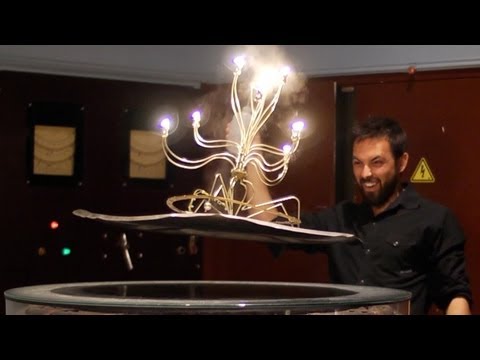
I treni a levitazione magnetica del tipo electrodynamic (giapponese JR-Maglev) sfruttano lo stesso meccanismo del magnete nel tubo di rame, capovolto: è il binario a essere conduttore (alluminio), mentre il treno porta a bordo elettromagneti superconduttori. Quando il treno si muove, nel binario nascono correnti parassite che, per Lenz, lo respingono verso l’alto. A bassissima velocità la levitazione non basta (Lenz è proporzionale alla velocità): per questo il treno parte appoggiato su ruote e si “stacca” superati circa km/h.
Cottura a induzione
La piastra a induzione delle cucine è un trasformatore aperto: sotto la superficie di vetroceramica c’è una bobina percorsa da una corrente alternata ad alta frequenza ( kHz). Il fondo della pentola, se di materiale ferromagnetico, fa da “secondario”: in esso si chiudono correnti parassite intensissime che lo scaldano per effetto Joule. La pentola in vetro o in alluminio puro non si scalda (poca permeabilità magnetica per il vetro; conducibilità troppo alta e spessore piccolo per l’alluminio, che a quelle frequenze diventa “trasparente” per effetto pelle). La piastra in sé resta fredda al tatto, perché è la pentola a essere il conduttore dissipativo (Bloomfield 2016). Vedi anche Riferimenti bibliografici.
Collegamenti
Argomenti: Induzione elettromagnetica Concetti: Correnti di Foucault · Effetto Joule
Esercizi collegati: Problema — La calamita nel tubo di rame · Esercizio svolto — magnete in tubo, velocità limite · Esercizio svolto — disco di Waltenhofen
Three widespread technologies exploit the dissipation of eddy currents.
Eddy current brake (Foucault)
High-speed trains, heavy vehicles and gym equipment (professional exercise bikes) use contactless electromagnetic brakes. A rotating metal disc (fixed to the wheel or flywheel) passes between the pole pieces of an electromagnet: the more we energise the electromagnet, the more eddy currents arise in the disc, the more kinetic energy is converted into heat. There is no wear or mechanical friction, but — by Lenz’s law — at zero speed the braking force vanishes: these brakes must always be paired with a mechanical brake to bring the vehicle to a complete stop.
Magnetic levitation (Maglev)
Electrodynamic-type magnetic levitation trains (the Japanese JR-Maglev) exploit the same mechanism as the magnet in the copper tube, upside down: it is the track that is the conductor (aluminium), while the train carries superconducting electromagnets on board. As the train moves, eddy currents arise in the track that, by Lenz’s law, repel it upward. At very low speed the levitation is not enough (the Lenz effect is proportional to speed): this is why the train starts out resting on wheels and “lifts off” once it exceeds about km/h.
Induction cooking
An induction hob is essentially an open transformer: beneath the glass-ceramic surface lies a coil carrying a high-frequency alternating current ( kHz). The base of the pan, if made of ferromagnetic material, acts as the “secondary”: very intense eddy currents form within it, heating it by Joule heating. A glass or pure-aluminium pan does not heat up (glass has too little magnetic permeability; aluminium’s conductivity is too high and its thickness too small, so at those frequencies it becomes “transparent” owing to the skin effect). The hob itself remains cool to the touch, because it is the pan that acts as the dissipative conductor (Bloomfield 2016). See also Riferimenti bibliografici.
Links
Topics: Electromagnetic induction Concepts: Eddy currents · Joule heating
Related exercises: Problem — The magnet in the copper tube · Worked exercise — magnet in a tube, terminal velocity · Worked exercise — Waltenhofen’s disc
Le correnti di Foucault non sono sempre benvenute: spesso sono pura perdita.
Quando Foucault è un nemico
Nei trasformatori e nei motori elettrici le correnti parassite nei nuclei in ferro sono indesiderate: dissipano energia preziosa in calore. Per questo i nuclei reali sono fatti di lamierini sottili (0,3–0,5 mm) impilati e isolati fra loro con vernice o ossido. I lamierini interrompono i circuiti possibili per le correnti, esattamente come le fessure radiali del pendolo di Waltenhofen “rotto”. Stessa fisica, lato opposto della medaglia.
Il criterio di progetto è quindi opposto a quello dei freni a induzione: là si massimizza la dissipazione, qui la si minimizza. Poiché la potenza dissipata cresce col quadrato dello spessore delle piastre, suddividere il nucleo in tanti sottili lamierini isolati abbatte drasticamente le perdite mantenendo intatto il percorso del flusso magnetico utile.
Collegamenti
Argomenti: Induzione elettromagnetica Concetti: Correnti di Foucault · Effetto Joule
Esercizi collegati: Problema — La calamita nel tubo di rame · Esercizio svolto — magnete in tubo, velocità limite · Esercizio svolto — disco di Waltenhofen
Eddy currents are not always welcome: often they are pure loss.
When Foucault is an enemy
In transformers and electric motors the eddy currents in the iron cores are unwanted: they dissipate precious energy as heat. This is why real cores are made of thin laminations (0.3–0.5 mm) stacked and insulated from each other with varnish or oxide. The laminations interrupt the possible circuits for the currents, exactly as the radial slots did in the “broken” Waltenhofen pendulum. Same physics, opposite side of the coin.
The design criterion is therefore the opposite of that for eddy current brakes: there dissipation is maximised, here it is minimised. Since the dissipated power grows with the square of the plate thickness, splitting the core into many thin insulated laminations drastically cuts the losses while leaving the useful magnetic flux path intact.
Links
Topics: Electromagnetic induction Concepts: Eddy currents · Joule heating
Related exercises: Problem — The magnet in the copper tube · Worked exercise — magnet in a tube, terminal velocity · Worked exercise — Waltenhofen’s disc