Finora abbiamo trattato i fluidi in equilibrio, cioè statici. Che cosa succede quando un fluido si muove? La risposta completa richiede un intero corso a parte, la fluidodinamica; qui ne diamo solo una pillola, sufficiente a spiegare alcuni fenomeni classici, dal volo di un aereo all’aspirazione di un foglio di carta. Due principi fanno da colonne portanti: la conservazione della portata, che nasce dal semplice fatto che il fluido non si accumula né sparisce, e il teorema di Bernoulli, che lega pressione, velocità e quota lungo una linea di flusso. Chiudiamo osservando dove questo modello ideale smette di funzionare, quando cioè entra in gioco la turbolenza.
So far we have treated fluids at equilibrium, that is, static ones. What happens when a fluid moves? The full answer requires an entire separate course, fluid dynamics; here we give only a taste of it, enough to explain a few classic phenomena, from the flight of an aircraft to the lifting of a sheet of paper. Two principles act as pillars: conservation of flow rate, which arises from the simple fact that fluid neither accumulates nor disappears, and Bernoulli’s theorem, which links pressure, velocity and height along a flow line. We close by observing where this ideal model stops working, that is, when turbulence comes into play.
Consideriamo un tubo che cambia sezione lungo il suo percorso, riempito di un fluido incomprimibile in moto stazionario. Poiché il fluido non si accumula in nessun punto né compare dal nulla, in ogni istante la stessa massa che entra da una sezione deve uscire dall’altra. Se il tubo si stringe, il fluido non ha altra scelta che scorrere più velocemente per far passare la stessa quantità di materia nello stesso tempo.
Principio — Equazione di continuità
Per un fluido incomprimibile in moto stazionario, il prodotto fra l’area della sezione e la velocità si conserva lungo il tubo:
La quantità , misurata in metri cubi al secondo, si chiama portata volumetrica e rappresenta il volume di fluido che attraversa una sezione nell’unità di tempo. L’equazione di continuità afferma dunque che, in un fluido incomprimibile, la portata è la stessa in ogni sezione del tubo: dove la sezione si riduce, la velocità aumenta in proporzione inversa, e viceversa.
Il tubo che si restringe
Quando il tubo si restringe, il fluido accelera. È la banale osservazione quotidiana dell’idraulica: strozzando l’estremità di una canna da giardino il getto esce più veloce, e un rubinetto sottile spruzza con velocità maggiore di uno largo a parità di portata.
Collegamenti
Argomenti: Fluidostatica e fluidodinamica
Esercizi collegati: Esercizio svolto — Pressa per la frutta · Esercizio svolto — Pressione del cuore · Esercizio svolto — Un pezzo di legno in acqua con benzina
Consider a pipe that changes cross-section along its length, filled with an incompressible fluid in steady motion. Since the fluid does not accumulate anywhere nor appear from nothing, at every instant the same mass entering one cross-section must leave from the other. If the pipe narrows, the fluid has no choice but to flow faster to let the same amount of matter pass in the same time.
Principle — Continuity equation
For an incompressible fluid in steady motion, the product of the cross-sectional area and the velocity is conserved along the pipe:
The quantity , measured in cubic metres per second, is called the volumetric flow rate and represents the volume of fluid crossing a cross-section per unit time. The continuity equation thus states that, in an incompressible fluid, the flow rate is the same at every cross-section of the pipe: where the cross-section shrinks, the velocity increases in inverse proportion, and vice versa.
The narrowing pipe
When the pipe narrows, the fluid speeds up. This is the everyday observation of plumbing: pinching the end of a garden hose makes the jet come out faster, and a narrow tap sprays with greater speed than a wide one for the same flow rate.
Links
Topics: Fluid statics and fluid dynamics
Related exercises: Worked exercise — Fruit press · Worked exercise — Blood pressure of the heart · Worked exercise — A piece of wood in water with petrol
Più sottile e più potente dell’equazione di continuità è il teorema che mette insieme pressione, velocità e quota di un fluido lungo una stessa linea di flusso. È il cuore concettuale della fluidodinamica elementare e spiega, con un’unica idea, fenomeni apparentemente diversi tra loro.
Legge — Teorema di Bernoulli
Per un fluido ideale (non viscoso, incomprimibile) in moto stazionario, lungo una linea di flusso vale La somma della pressione statica , della pressione dinamica e del termine gravitazionale è la stessa in ogni punto della linea di flusso.
Formula chiave
È la conservazione dell’energia scritta per unità di volume del fluido.
L’interpretazione del teorema è infatti energetica. Ciascun termine è un’energia per unità di volume: è l’energia di compressione, è l’energia cinetica e è l’energia potenziale gravitazionale, tutte riferite all’unità di volume di fluido. Che la loro somma resti costante lungo una stessa linea di flusso è semplicemente il principio di conservazione dell’energia applicato al fluido in moto (Lauga 2022; vedi Riferimenti bibliografici).
Una conseguenza immediata, e forse controintuitiva, si ottiene quando la quota non cambia.
Principio — Effetto Venturi
A quota costante (), dove la velocità del fluido aumenta la pressione diminuisce:
Là dove il fluido corre più veloce, dunque, la pressione è più bassa. Questo legame inverso tra velocità e pressione è la chiave per capire i due esempi che seguono.
Portanza di un'ala d'aereo
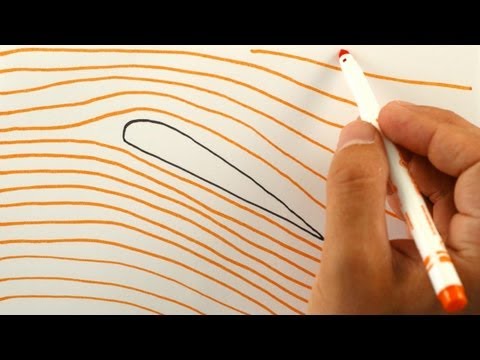
Un’ala d’aereo ha la faccia superiore curva e quella inferiore quasi piatta, ed è inclinata di un angolo d’attacco rispetto al flusso. La differenza di pressione non nasce perché l’aria sopra e sotto «impiega lo stesso tempo»: quel racconto è falso, e l’aria che passa sopra arriva prima al bordo d’uscita. La pressione più bassa sul dorso viene dalla curvatura del flusso e dall’angolo d’attacco. Bernoulli lega poi quella pressione alla velocità locale: dove il flusso è più veloce, la pressione è più bassa. La differenza, moltiplicata per l’area dell’ala, dà la forza di portanza.
Per un Boeing 747 (massa dell’ordine di , area alare di circa , velocità di crociera ) la portanza per unità d’area deve valere . Con la densità al livello del mare, , e ne segue : una differenza di circa il . In crociera, a –, e la stessa portanza chiede una differenza di velocità più grande.
Foglio di carta che "si solleva"
Tieni un foglio di carta floscio in mano, parallelo al pavimento, e soffia orizzontalmente sopra la sua faccia superiore: il foglio si alza. Sopra la velocità dell’aria è alta (il tuo respiro), sotto è praticamente nulla; per Bernoulli, sopra la pressione è minore e sotto resta quella atmosferica, e la differenza spinge il foglio verso l’alto. È un esperimento da banco di scuola che mostra in diretta l’effetto Venturi.
Formula chiave — Teorema di Torricelli (efflusso da un foro)
Un serbatoio aperto e largo è pieno d’acqua; a una profondità sotto il pelo libero c’è un piccolo foro. Applichiamo il teorema di Bernoulli fra il pelo libero (punto 1) e il getto appena uscito dal foro (punto 2). In tutti e due i punti la pressione è quella atmosferica, che quindi si elide. Se il serbatoio è molto più largo del foro, per la conservazione della portata il livello scende lentamente e la velocità nel punto 1 è trascurabile. Resta , cioè
È il teorema di Torricelli: il liquido esce con la stessa velocità che avrebbe un sasso lasciato cadere da un’altezza . La velocità non dipende dalla densità del liquido né dalla forma del serbatoio, ma solo dal dislivello fra il pelo libero e il foro. Lo stesso risultato compare nell’esercizio Sifone dalla bottiglia.
Dove arriva il getto. Da un foro nella parete laterale, a quota sopra il suolo, il getto esce orizzontale con velocità : da lì in poi è un lancio orizzontale. Arriva al suolo dopo un tempo , alla distanza
Esempio. Il pelo libero è a dal suolo e il foro è più in basso, cioè a dal suolo (). Allora , e . Un foro sotto il pelo libero, cioè a dal suolo, manda il getto alla stessa distanza, perché e si scambiano. Il getto più lungo, , esce dal foro a metà altezza.
Il serbatoio si svuota sempre più lentamente. Mentre il livello scende, diminuisce e con essa la velocità di uscita: la portata cala e lo svuotamento rallenta verso la fine.
Limiti del modello. Per l’acqua la velocità del getto è molto vicina a : la viscosità conta poco, e la gittata resta una buona stima. La portata invece è sensibilmente minore del prodotto fra l’area del foro e , perché subito dopo il foro il getto si restringe (vena contratta): per un foro circolare in una parete sottile la sezione del getto è circa due terzi di quella del foro (vedi Limiti del modello e regime turbolento).
Da non confondere con l’esperimento di Torricelli sulla pressione atmosferica, il barometro a mercurio: vedi Manometro e barometro.
Teorema di Torricelli: il getto esce dal foro con e, da quota , arriva a distanza .
Collegamenti
Argomenti: Fluidostatica e fluidodinamica Concetti: Teorema di Bernoulli · Pressione Oggetti: Ala d’aereo
Esercizi collegati: Esercizio svolto — Pressa per la frutta · Esercizio svolto — Pressione del cuore · Esercizio svolto — La colonna d’aria che schiaccia i nostri piedi · Esercizio svolto — Sifone dalla bottiglia
More subtle and more powerful than the continuity equation is the theorem that ties together pressure, velocity and height of a fluid along a single flow line. It is the conceptual core of elementary fluid dynamics and explains, with a single idea, phenomena that seem quite different from one another.
Law — Bernoulli's theorem
For an ideal fluid (non-viscous, incompressible) in steady motion, along a flow line The sum of the static pressure , the dynamic pressure and the gravitational term is the same at every point of the flow line.
Key formula
This is energy conservation written per unit volume of fluid.
The interpretation of the theorem is indeed energetic. Each term is an energy per unit volume: is the compression energy, is the kinetic energy and is the gravitational potential energy, all referred to the unit volume of fluid. That their sum stays constant along a single flow line is simply the principle of energy conservation applied to the moving fluid (Lauga 2022; see Riferimenti bibliografici).
An immediate, and perhaps counterintuitive, consequence is obtained when the height does not change.
Principle — Venturi effect
At constant height (), where the fluid velocity increases the pressure decreases:
Where the fluid runs faster, then, the pressure is lower. This inverse relationship between velocity and pressure is the key to understanding the two examples that follow.
Lift on an aircraft wing
An aircraft wing has a curved upper surface and an almost flat lower one, and it meets the flow at an angle of attack. The pressure difference does not arise because the air above and below «takes the same time»: that story is false, and the air passing over the top reaches the trailing edge first. The lower pressure on the upper surface comes from the curvature of the flow and from the angle of attack. Bernoulli then ties that pressure to the local speed: where the flow is faster, the pressure is lower. The difference, multiplied by the wing area, gives the lift force.
For a Boeing 747 (mass of order , wing area about , cruising speed ) the lift per unit area must equal . With sea-level density, , and it follows that : a difference of about . In cruise, at –, and the same lift asks for a larger speed difference.
Sheet of paper that "lifts"
Hold a floppy sheet of paper in your hand, parallel to the floor, and blow horizontally across its upper face: the sheet rises. Above, the air speed is high (your breath), below it is practically zero; by Bernoulli, above the pressure is lower and below it stays atmospheric, and the difference pushes the sheet upward. It is a classroom-bench experiment that shows the Venturi effect live.
Key formula — Torricelli's theorem (efflux from a hole)
A wide open tank is full of water; at a depth below the free surface there is a small hole. Apply Bernoulli’s theorem between the free surface (point 1) and the jet just after it leaves the hole (point 2). At both points the pressure is atmospheric, so it cancels. If the tank is much wider than the hole, by conservation of flow rate the level falls slowly and the speed at point 1 is negligible. What remains is , that is
This is Torricelli’s theorem: the liquid comes out with the same speed as a stone dropped from a height . The speed depends neither on the density of the liquid nor on the shape of the tank, only on the height difference between the free surface and the hole. The same result appears in the exercise Siphon from a bottle.
Where the jet lands. From a hole in the side wall, at height above the ground, the jet comes out horizontally with speed : from there on it is a horizontal launch. It reaches the ground after a time , at a distance
Example. The free surface is above the ground and the hole is lower, that is above the ground (). Then , and . A hole below the free surface, that is above the ground, sends the jet to the same distance, because and swap. The longest jet, , comes from the hole at half height.
The tank empties more and more slowly. As the level falls, decreases and so does the outflow speed: the flow rate drops and emptying slows down towards the end.
Limits of the model. For water the speed of the jet is very close to : viscosity matters little, and the range remains a good estimate. The flow rate, however, is markedly smaller than the area of the hole times , because just after the hole the jet narrows (vena contracta): for a round hole in a thin wall the cross-section of the jet is about two thirds of that of the hole (see Limits of the model and turbulent flow).
Not to be confused with Torricelli’s experiment on atmospheric pressure, the mercury barometer: see Manometer and barometer.
Torricelli’s theorem: the jet leaves the hole with and, from height , lands at a distance .
Links
Topics: Fluid statics and fluid dynamics Concepts: Bernoulli’s theorem · Pressure Objects: Aircraft wing
Related exercises: Worked exercise — Fruit press · Worked exercise — Blood pressure of the heart · Worked exercise — The column of air pressing on our feet · Worked exercise — Siphon from the bottle
Il teorema di Bernoulli vale per un fluido ideale: incomprimibile, non viscoso, in moto stazionario lungo una linea di flusso. I fluidi reali, però, hanno viscosità: gli strati di fluido in moto relativo si ostacolano a vicenda per attrito interno, dissipando energia. Per stabilire quando la viscosità domina, o quando invece è trascurabile, si introduce un numero puro, il numero di Reynolds:
dove è una lunghezza caratteristica del problema (il diametro del tubo, la corda dell’ala) ed è la viscosità dinamica del fluido. Il numero di Reynolds confronta l’importanza delle forze d’inerzia con quella delle forze viscose: quando è piccolo dominano le seconde, quando è grande dominano le prime. A seconda del suo valore si distinguono tre regimi di moto.
- Laminare (): il fluido scorre a strati paralleli ben ordinati. Per grandi, lontano dalle pareti, Bernoulli è una buona approssimazione; per piccoli dominano gli effetti viscosi e serve la legge di Poiseuille (vedi sotto).
- Transizione (): il moto diventa irregolare, con vortici intermittenti che compaiono e scompaiono.
- Turbolento (): si formano vortici su tutte le scale, l’energia cinetica viene dissipata in calore e Bernoulli fallisce.
La tabella seguente mostra quanto vari il numero di Reynolds nelle situazioni più diverse, dal nuoto microscopico di uno spermatozoo al volo di un aereo di linea.
| Situazione | tipico |
|---|---|
| Spermatozoo che nuota | |
| Sangue nelle arteriole | |
| Sangue nell’aorta | |
| Aria in una stanza | |
| Ala di Boeing 747 |
Il moto viscoso in un tubo: la legge di Poiseuille
Quando il moto è laminare e la viscosità non è trascurabile, Bernoulli non basta più: per far scorrere un fluido viscoso in un tubo orizzontale di sezione costante serve una differenza di pressione fra le estremità, che compensa l’attrito interno. Gli strati di fluido a contatto con la parete restano fermi, quelli al centro sono i più veloci. Il legame fra la portata e la differenza di pressione fu trovato sperimentalmente, in modo indipendente, dall’ingegnere tedesco Gotthilf Hagen (1839) e dal medico francese Jean Léonard Marie Poiseuille, che studiava proprio la circolazione del sangue: per questo si parla anche di legge di Hagen-Poiseuille.
Formula chiave — Legge di Poiseuille
dove è la portata volumetrica (), il raggio interno del tubo (), la differenza di pressione fra le due estremità (), la viscosità dinamica del fluido () e la lunghezza del tubo ().
La portata è proporzionale a e inversamente proporzionale a e a : niente di sorprendente. La dipendenza sorprendente è quella dal raggio, che compare alla quarta potenza. Se il raggio si dimezza, a parità di la portata diventa di quella iniziale. Basta un restringimento del () per ridurre la portata a circa il (). Per questo piccole variazioni del diametro dei vasi sanguigni hanno effetti enormi sul flusso.
Quando vale
La legge di Poiseuille vale per un fluido newtoniano (viscosità costante, come acqua e olio; il sangue lo è solo in prima approssimazione), in regime laminare (numero di Reynolds basso, ben sotto ) e in moto stazionario in un tubo rigido, rettilineo, a sezione circolare costante. In regime turbolento la portata cresce molto meno che in proporzione a .
Resistenza idraulica e analogia con la legge di Ohm
Riscriviamo la legge nella forma , con La grandezza è la resistenza idraulica del tubo e si misura in . La forma ha la stessa struttura della prima legge di Ohm, , che incontrerai nel capitolo sui circuiti elettrici:
| Circuito idraulico | Circuito elettrico |
|---|---|
| differenza di pressione | differenza di potenziale |
| portata | intensità di corrente |
| resistenza idraulica | resistenza elettrica |
| la pompa (il cuore) | il generatore (la pila) |
L’analogia funziona anche per i collegamenti, con le stesse regole delle resistenze elettriche.
- In serie (tubi uno dopo l’altro, attraversati dalla stessa portata): le cadute di pressione si sommano, quindi
- In parallelo (tubi affiancati, con la stessa ai capi): le portate si sommano, quindi
Nel corpo umano i capillari sono sottilissimi, e quindi ciascuno ha una resistenza enorme; ma sono miliardi collegati in parallelo, e la loro resistenza complessiva resta contenuta. Le arteriole, invece, sono poche in confronto e possono cambiare raggio: per questo sono loro a “regolare il rubinetto” della circolazione.
Testo
Un’arteriola ha raggio interno e lunghezza ; fra le sue estremità c’è una differenza di pressione . Tratta il sangue come un fluido newtoniano con viscosità e densità . Calcola: (a) la resistenza idraulica dell’arteriola; (b) la portata e la velocità media del sangue; (c) il numero di Reynolds, per verificare che il moto sia laminare; (d) di quanto cambia la portata se, per vasocostrizione, il raggio si riduce del a parità di , e quale servirebbe per mantenere la portata iniziale.
Soluzione
(a) Con si ha , quindi (b) Dalla “legge di Ohm idraulica”: cioè circa al secondo. Dividendo per l’area della sezione si ottiene la velocità media: (c) Usando come lunghezza caratteristica il diametro : molto meno di : il moto è laminare e la legge di Poiseuille è applicabile (in accordo con la tabella sopra). (d) Il nuovo raggio è , quindi la portata si moltiplica per e scende a circa il del valore iniziale, cioè a : una riduzione del per un restringimento di appena un quinto. Per ripristinare la portata iniziale la differenza di pressione dovrebbe crescere dello stesso fattore inverso: È il meccanismo con cui la vasocostrizione diffusa fa salire la pressione arteriosa: il cuore deve “spingere” di più per far passare lo stesso flusso di sangue.
Sintesi
Continuità: — Bernoulli: — Reynolds piccolo: fluido viscoso, moto a lamine; Reynolds grande: moto turbolento. Effetto Venturi: dove il fluido è più veloce, la pressione è minore. Poiseuille: in un tubo, con moto laminare, ; la portata dipende dalla quarta potenza del raggio.

Collegamenti
Argomenti: Fluidostatica e fluidodinamica
Esercizi collegati: Esercizio svolto — Pressa per la frutta · Esercizio svolto — Pressione del cuore · Esercizio svolto — Un pezzo di legno in acqua con benzina
Bernoulli’s theorem holds for an ideal fluid: incompressible, non-viscous, in steady motion along a flow line. Real fluids, however, have viscosity: layers of fluid in relative motion hinder each other through internal friction, dissipating energy. To establish when viscosity dominates, or when instead it is negligible, we introduce a pure number, the Reynolds number:
where is a characteristic length of the problem (the pipe diameter, the wing chord) and is the dynamic viscosity of the fluid. The Reynolds number compares the importance of inertial forces with that of viscous forces: when it is small the latter dominate, when it is large the former dominate. Depending on its value, three flow regimes are distinguished.
- Laminar (): the fluid flows in well-ordered parallel layers. For large , away from the walls, Bernoulli is a good approximation; for small viscous effects dominate and Poiseuille’s law is needed (see below).
- Transition (): the motion becomes irregular, with intermittent vortices appearing and disappearing.
- Turbulent (): vortices form at all scales, kinetic energy is dissipated as heat and Bernoulli fails.
The table below shows how much the Reynolds number varies across very different situations, from the microscopic swimming of a sperm cell to the flight of an airliner.
| Situation | Typical |
|---|---|
| Swimming sperm cell | |
| Blood in arterioles | |
| Blood in the aorta | |
| Air in a room | |
| Boeing 747 wing |
Viscous flow in a pipe: Poiseuille’s law
When the flow is laminar and viscosity is not negligible, Bernoulli is no longer enough: to make a viscous fluid flow through a horizontal pipe of constant cross-section, a pressure difference between the ends is needed, to make up for the internal friction. The layers of fluid in contact with the wall stay still, those at the centre are the fastest. The relation between flow rate and pressure difference was found experimentally, independently, by the German engineer Gotthilf Hagen (1839) and by the French physician Jean Léonard Marie Poiseuille, who was studying blood circulation: this is why it is also called the Hagen–Poiseuille law.
Key formula — Poiseuille's law
where is the volume flow rate (), the inner radius of the pipe (), the pressure difference between the two ends (), the dynamic viscosity of the fluid () and the length of the pipe ().
The flow rate is proportional to and inversely proportional to and to : nothing surprising. The surprising dependence is the one on the radius, which appears to the fourth power. If the radius is halved, at the same the flow rate becomes of the initial one. A narrowing of just () is enough to reduce the flow rate to about (). This is why small changes in the diameter of blood vessels have huge effects on the flow.
When it holds
Poiseuille’s law holds for a Newtonian fluid (constant viscosity, like water and oil; blood is one only to a first approximation), in the laminar regime (low Reynolds number, well below ) and in steady flow in a rigid, straight pipe of constant circular cross-section. In the turbulent regime the flow rate grows much less than in proportion to .
Hydraulic resistance and the analogy with Ohm’s law
Let us rewrite the law in the form , with The quantity is the hydraulic resistance of the pipe and is measured in . The form has the same structure as Ohm’s first law, , which you will meet in the chapter on electric circuits:
| Hydraulic circuit | Electric circuit |
|---|---|
| pressure difference | potential difference |
| flow rate | current |
| hydraulic resistance | electrical resistance |
| the pump (the heart) | the generator (the battery) |
The analogy also works for connections, with the same rules as for electrical resistors.
- In series (pipes one after the other, carrying the same flow rate): the pressure drops add up, so
- In parallel (pipes side by side, with the same across them): the flow rates add up, so
In the human body the capillaries are extremely thin, so each one has an enormous resistance; but there are billions of them connected in parallel, and their total resistance stays moderate. The arterioles, on the other hand, are few by comparison and can change their radius: this is why they are the ones that “turn the tap” of the circulation.
Problem
An arteriole has inner radius and length ; between its ends there is a pressure difference . Treat blood as a Newtonian fluid with viscosity and density . Calculate: (a) the hydraulic resistance of the arteriole; (b) the flow rate and the mean speed of the blood; (c) the Reynolds number, to check that the flow is laminar; (d) how much the flow rate changes if, through vasoconstriction, the radius shrinks by at the same , and what would be needed to keep the initial flow rate.
Solution
(a) With we have , so (b) From the “hydraulic Ohm’s law”: that is, about per second. Dividing by the cross-sectional area gives the mean speed: (c) Using the diameter as the characteristic length: far less than : the flow is laminar and Poiseuille’s law applies (in agreement with the table above). (d) The new radius is , so the flow rate is multiplied by and drops to about of the initial value, i.e. to : a reduction for a narrowing of just one fifth. To restore the initial flow rate the pressure difference would have to grow by the same inverse factor: This is the mechanism by which widespread vasoconstriction raises blood pressure: the heart has to “push” harder to get the same blood flow through.
Summary
Continuity: — Bernoulli: — small Reynolds: viscous fluid, layered flow; large Reynolds: turbulent flow. Venturi effect: where the fluid is faster, the pressure is lower. Poiseuille: in a pipe, with laminar flow, ; the flow rate depends on the fourth power of the radius.
Links
Topics: Fluid statics and fluid dynamics
Related exercises: Worked exercise — Fruit press · Worked exercise — Blood pressure of the heart · Worked exercise — A piece of wood in water with petrol