Una delle conseguenze più celebri e profonde della relatività ristretta è che la massa stessa è una forma di energia. Questa sezione parte dalla formula , passa alla quantità di moto relativistica e all’invariante energia-impulso che lega tutti i sistemi di riferimento, e si chiude con una sorpresa elettromagnetica: il campo di un solenoide che cambia intensità a seconda di chi lo guarda.
One of the most celebrated and profound consequences of special relativity is that mass itself is a form of energy. This section starts from the formula , moves on to relativistic momentum and the energy–momentum invariant that links every reference frame, and closes with an electromagnetic surprise: the field of a solenoid whose intensity changes depending on who is looking at it.
Una delle conseguenze più celebri della relatività ristretta è che la massa stessa è una forma di energia. Einstein dimostrò che l’energia totale di una particella libera di massa non è solo la sua energia cinetica, ma include un termine che dipende dalla sola massa:
Il caso più interessante è la particella a riposo. Per si ha , e ciò che rimane è l’energia a riposo:
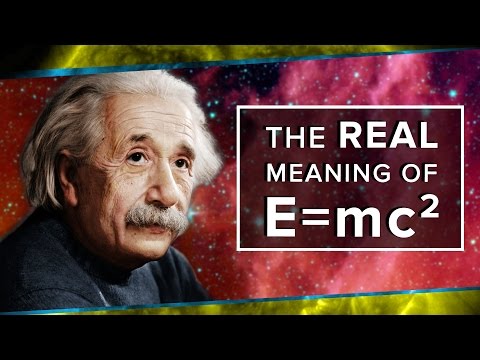
È la formula più famosa della fisica. Dice qualcosa di sorprendente: una massa anche piccola nasconde una quantità enorme di energia, perché il fattore di conversione è gigantesco. Una massa di appena contiene un’energia di , equivalente a milioni di tonnellate di TNT. Massa ed energia non sono due grandezze separate collegate da una formula: sono la stessa cosa, misurata in unità diverse.
Da Hiroshima alle centrali nucleari
La formula ricevette la sua più drammatica (e tragica) conferma nel 1945 con le bombe atomiche di Hiroshima e Nagasaki: meno di un grammo di uranio convertito in energia rade al suolo una città. La stessa formula spiega però anche il Sole (fusione nucleare: ogni secondo di idrogeno si trasformano in energia), le centrali nucleari (fissione) e il PET scan medico (annichilazione elettrone-positrone). Sempre lo stesso principio: un pizzico di massa che sparisce, un fiume di energia che appare.

Collegamenti
Argomenti: Relatività ristretta Concetti: Equivalenza massa-energia
Esercizi collegati: Problema — Particella o fotone · Esercizio svolto — Il bosone di Higgs a 0,8c · Problema — Energia di una bomba a fissione
One of the most celebrated consequences of special relativity is that mass itself is a form of energy. Einstein showed that the total energy of a free particle of mass is not just its kinetic energy, but includes a term depending on mass alone:
The most interesting case is the particle at rest. For we have , and what remains is the rest energy:
It is the most famous formula in physics. It says something surprising: even a small mass hides an enormous amount of energy, because the conversion factor is gigantic. A mass of just contains an energy of , equivalent to millions of tonnes of TNT. Mass and energy are not two separate quantities linked by a formula: they are the same thing, measured in different units.
From Hiroshima to nuclear power plants
The formula received its most dramatic (and tragic) confirmation in 1945 with the atomic bombs of Hiroshima and Nagasaki: less than a gram of uranium converted into energy razes a city to the ground. The same formula, however, also explains the Sun (nuclear fusion: every second of hydrogen are converted into energy), nuclear power plants (fission) and medical PET scans (electron-positron annihilation). Always the same principle: a pinch of mass that disappears, a river of energy that appears.
Links
Topics: Special relativity Concepts: Mass-energy equivalence
Related exercises: Problem — Particle or photon · Worked exercise — The Higgs boson at 0.8c · Problem — Energy of a fission bomb
Anche la quantità di moto cambia in relatività. Per una particella di massa che si muove a velocità non vale più il semplice di Newton, ma la sua versione corretta dal fattore di Lorentz:
La presenza di ha una conseguenza spettacolare: quando , il fattore e quindi . L’inerzia “effettiva” della particella diverge — servirebbe una spinta infinita per accelerarla ancora un po’ — ed è questa un’altra ragione profonda per cui nessun oggetto massivo può raggiungere la velocità della luce.
Combinando energia e quantità di moto si trova una relazione dalla bellezza sorprendente. Se in un sistema di riferimento la particella ha energia e impulso , la combinazione non cambia passando da un sistema all’altro: è un invariante.
Principio — Invariante energia-impulso
Il membro di destra dipende solo dalla massa a riposo ed è lo stesso in tutti i sistemi di riferimento.
Questo è potentissimo dal punto di vista pratico: misurando e in un qualsiasi sistema di riferimento — per quanto la particella si stia muovendo velocemente — si può dedurre la sua massa a riposo, che è una proprietà intrinseca e non dipende dallo stato di moto. È il modo in cui, negli acceleratori, si identificano le particelle a partire dalle loro tracce.
Formula chiave
Fotone: , quindi .
Il caso limite del fotone è particolarmente istruttivo. Ponendo nell’invariante, il membro di destra si annulla e resta : una particella senza massa può comunque trasportare energia e quantità di moto, purché viaggi esattamente a . La luce non è “materia leggera”, è qualcosa di qualitativamente diverso, e l’invariante energia-impulso lo cattura in una riga.
Collegamenti
Argomenti: Relatività ristretta Concetti: Quantità di moto relativistica
Esercizi collegati: Problema — Particella o fotone · Esercizio svolto — Il bosone di Higgs a 0,8c · Problema — Perché nessuna massa raggiunge c
Momentum also changes in relativity. For a particle of mass moving with velocity , Newton’s simple no longer holds; instead it is corrected by the Lorentz factor:
The presence of has a spectacular consequence: as , the factor and so . The particle’s “effective” inertia diverges — an infinite push would be needed to accelerate it even a little more — and this is another profound reason why no massive object can reach the speed of light.
Combining energy and momentum reveals a relation of striking beauty. If in a given reference frame the particle has energy and momentum , the combination does not change when passing from one frame to another: it is an invariant.
Principle — Energy–momentum invariant
The right-hand side depends only on the rest mass and is the same in every reference frame.
This is extremely powerful from a practical standpoint: by measuring and in any reference frame — however fast the particle is moving — one can deduce its rest mass, an intrinsic property that does not depend on the state of motion. This is how particles are identified from their tracks at accelerators.
Key formula
Photon: , hence .
The limiting case of the photon is particularly instructive. Setting in the invariant, the right-hand side vanishes and we are left with : a massless particle can still carry energy and momentum, provided it travels at exactly . Light is not “light matter” — it is something qualitatively different, and the energy–momentum invariant captures this in a single line.
Links
Topics: Special Relativity Concepts: Relativistic momentum
Related exercises: Problem — Particle or photon · Worked exercise — The Higgs boson at 0.8c · Problem — Why no mass reaches c
Chiudiamo con una sorpresa che collega la relatività all’elettromagnetismo in modo elegante e quasi elementare. Un solenoide di spire e lunghezza , percorso da corrente , produce al suo interno un campo magnetico
misurato nel suo sistema di riferimento proprio, SRB. Ora consideriamo un osservatore SRA che vede il solenoide muoversi a velocità lungo il proprio asse. Per la contrazione delle lunghezze, nel SRA il solenoide è più corto:
Il punto cruciale è che il numero di spire resta invariante: è un conteggio oggettivo, perché gli atomi del filo sono gli stessi in ogni sistema di riferimento e nessuna spira può apparire o sparire cambiando osservatore. Ma se resta fisso mentre la lunghezza si contrae di un fattore , allora nel SRA la densità di spire è più grande dello stesso fattore. Il campo cresce di conseguenza:
Il campo magnetico è dunque più intenso proprio perché le spire, contratte, sono state stipate più vicine tra loro. Questo è un modo particolarmente pulito di dimostrare che e “si mescolano” sotto le trasformazioni di Lorentz: il concetto stesso di “campo magnetico puro” è relativo al sistema di riferimento, e lo stesso filo, guardato da un altro SR, produce un campo diverso. Einstein usò proprio questo tipo di argomento — geometrico, senza mai invocare il formalismo dei tensori — per convincersi che elettromagnetismo e relatività fossero inseparabili, due facce di una stessa struttura.
Collegamenti
Argomenti: Relatività ristretta Concetti: Contrazione delle lunghezze Oggetti: Solenoide
Esercizi collegati: Problema — Galleria a 0,8c · Problema — Contrazione di un’asta · Problema — Il fienile e il bastone
We close with a surprise that links relativity to electromagnetism in an elegant and almost elementary way. A solenoid with turns and length , carrying current , produces inside it a magnetic field
measured in its own proper reference frame, SRB. Now consider an observer SRA who sees the solenoid moving with velocity along its own axis. By length contraction, in SRA the solenoid is shorter:
The crucial point is that the number of turns remains invariant: it is an objective count, because the atoms of the wire are the same in every reference frame and no turn can appear or disappear by changing observer. But if stays fixed while the length contracts by a factor , then in SRA the turn density is larger by that same factor. The field grows accordingly:
The magnetic field is therefore more intense precisely because the contracted turns have been packed closer together. This is a particularly clean way to show that and “mix” under Lorentz transformations: the very concept of a “pure magnetic field” is relative to the reference frame, and the same wire, viewed from a different SR, produces a different field. Einstein used exactly this kind of argument — geometric, never invoking tensor formalism — to convince himself that electromagnetism and relativity were inseparable, two faces of the same structure.
Links
Topics: Special Relativity Concepts: Length contraction Objects: Solenoid
Related exercises: Problem — Tunnel at 0.8c · Problem — Contraction of a rod · Problem — The barn and the pole