Finora abbiamo trattato i fluidi in equilibrio, cioè statici. Che cosa succede quando un fluido si muove? La risposta completa richiede un intero corso a parte, la fluidodinamica; qui ne diamo solo una pillola, sufficiente a spiegare alcuni fenomeni classici, dal volo di un aereo all’aspirazione di un foglio di carta. Due principi fanno da colonne portanti: la conservazione della portata, che nasce dal semplice fatto che il fluido non si accumula né sparisce, e il teorema di Bernoulli, che lega pressione, velocità e quota lungo una linea di flusso. Chiudiamo osservando dove questo modello ideale smette di funzionare, quando cioè entra in gioco la turbolenza.
So far we have treated fluids at equilibrium, that is, static ones. What happens when a fluid moves? The full answer requires an entire separate course, fluid dynamics; here we give only a taste of it, enough to explain a few classic phenomena, from the flight of an aircraft to the lifting of a sheet of paper. Two principles act as pillars: conservation of flow rate, which arises from the simple fact that fluid neither accumulates nor disappears, and Bernoulli’s theorem, which links pressure, velocity and height along a flow line. We close by observing where this ideal model stops working, that is, when turbulence comes into play.
Consideriamo un tubo che cambia sezione lungo il suo percorso, riempito di un fluido incomprimibile in moto stazionario. Poiché il fluido non si accumula in nessun punto né compare dal nulla, in ogni istante la stessa massa che entra da una sezione deve uscire dall’altra. Se il tubo si stringe, il fluido non ha altra scelta che scorrere più velocemente per far passare la stessa quantità di materia nello stesso tempo.
Principio — Equazione di continuità
Per un fluido incomprimibile in moto stazionario, il prodotto fra l’area della sezione e la velocità si conserva lungo il tubo:
La quantità , misurata in metri cubi al secondo, si chiama portata volumetrica e rappresenta il volume di fluido che attraversa una sezione nell’unità di tempo. L’equazione di continuità afferma dunque che, in un fluido incomprimibile, la portata è la stessa in ogni sezione del tubo: dove la sezione si riduce, la velocità aumenta in proporzione inversa, e viceversa.
Il tubo che si restringe
Quando il tubo si restringe, il fluido accelera. È la banale osservazione quotidiana dell’idraulica: strozzando l’estremità di una canna da giardino il getto esce più veloce, e un rubinetto sottile spruzza con velocità maggiore di uno largo a parità di portata.
Collegamenti
Argomenti: Fluidostatica e fluidodinamica
Esercizi collegati: Esercizio svolto — Pressa per la frutta · Esercizio svolto — Pressione del cuore · Esercizio svolto — Un pezzo di legno in acqua con benzina
Consider a pipe that changes cross-section along its length, filled with an incompressible fluid in steady motion. Since the fluid does not accumulate anywhere nor appear from nothing, at every instant the same mass entering one cross-section must leave from the other. If the pipe narrows, the fluid has no choice but to flow faster to let the same amount of matter pass in the same time.
Principle — Continuity equation
For an incompressible fluid in steady motion, the product of the cross-sectional area and the velocity is conserved along the pipe:
The quantity , measured in cubic metres per second, is called the volumetric flow rate and represents the volume of fluid crossing a cross-section per unit time. The continuity equation thus states that, in an incompressible fluid, the flow rate is the same at every cross-section of the pipe: where the cross-section shrinks, the velocity increases in inverse proportion, and vice versa.
The narrowing pipe
When the pipe narrows, the fluid speeds up. This is the everyday observation of plumbing: pinching the end of a garden hose makes the jet come out faster, and a narrow tap sprays with greater speed than a wide one for the same flow rate.
Links
Topics: Fluid statics and fluid dynamics
Related exercises: Worked exercise — Fruit press · Worked exercise — Blood pressure of the heart · Worked exercise — A piece of wood in water with petrol
Più sottile e più potente dell’equazione di continuità è il teorema che mette insieme pressione, velocità e quota di un fluido lungo una stessa linea di flusso. È il cuore concettuale della fluidodinamica elementare e spiega, con un’unica idea, fenomeni apparentemente diversi tra loro.
Legge — Teorema di Bernoulli
Per un fluido ideale (non viscoso, incomprimibile) in moto stazionario, lungo una linea di flusso vale La somma della pressione statica , della pressione dinamica e del termine gravitazionale è la stessa in ogni punto della linea di flusso.
Formula chiave
È la conservazione dell’energia scritta per unità di volume del fluido.
L’interpretazione del teorema è infatti energetica. Ciascun termine è un’energia per unità di volume: è l’energia di compressione, è l’energia cinetica e è l’energia potenziale gravitazionale, tutte riferite all’unità di volume di fluido. Che la loro somma resti costante lungo una stessa linea di flusso è semplicemente il principio di conservazione dell’energia applicato al fluido in moto (Lauga 2022; vedi Riferimenti bibliografici).
Una conseguenza immediata, e forse controintuitiva, si ottiene quando la quota non cambia.
Principio — Effetto Venturi
A quota costante (), dove la velocità del fluido aumenta la pressione diminuisce:
Là dove il fluido corre più veloce, dunque, la pressione è più bassa. Questo legame inverso tra velocità e pressione è la chiave per capire i due esempi che seguono.
Portanza di un'ala d'aereo
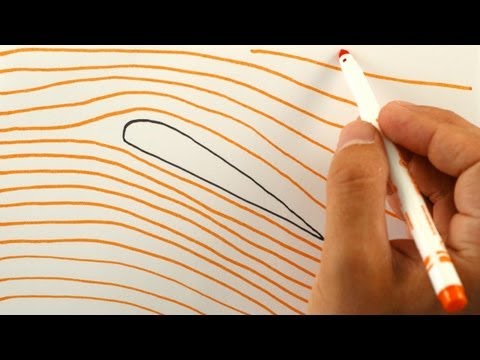
Un’ala d’aereo ha la faccia superiore curva e quella inferiore quasi piatta. Il flusso d’aria che passa sopra deve percorrere un cammino più lungo nello stesso tempo, e corre quindi più veloce di quello che passa sotto. Per il teorema di Bernoulli, sopra l’ala la pressione è più bassa e sotto è più alta: la differenza di pressione, moltiplicata per l’area dell’ala, dà la forza di portanza che sostiene l’aereo.
Per un Boeing 747 (massa dell’ordine di , area alare di circa , velocità di crociera ) la portanza per unità d’area deve valere . Con e ne segue : basta una differenza di velocità del circa per tenere in aria tonnellate.
Foglio di carta che "si solleva"
Tieni un foglio di carta floscio in mano, parallelo al pavimento, e soffia orizzontalmente sopra la sua faccia superiore: il foglio si alza. Sopra la velocità dell’aria è alta (il tuo respiro), sotto è praticamente nulla; per Bernoulli, sopra la pressione è minore e sotto resta quella atmosferica, e la differenza spinge il foglio verso l’alto. È un esperimento da banco di scuola che mostra in diretta l’effetto Venturi.
Collegamenti
Argomenti: Fluidostatica e fluidodinamica Concetti: Teorema di Bernoulli · Pressione Oggetti: Ala d’aereo
Esercizi collegati: Esercizio svolto — Pressa per la frutta · Esercizio svolto — Pressione del cuore · Esercizio svolto — La colonna d’aria che schiaccia i nostri piedi
More subtle and more powerful than the continuity equation is the theorem that ties together pressure, velocity and height of a fluid along a single flow line. It is the conceptual core of elementary fluid dynamics and explains, with a single idea, phenomena that seem quite different from one another.
Law — Bernoulli's theorem
For an ideal fluid (non-viscous, incompressible) in steady motion, along a flow line The sum of the static pressure , the dynamic pressure and the gravitational term is the same at every point of the flow line.
Key formula
This is energy conservation written per unit volume of fluid.
The interpretation of the theorem is indeed energetic. Each term is an energy per unit volume: is the compression energy, is the kinetic energy and is the gravitational potential energy, all referred to the unit volume of fluid. That their sum stays constant along a single flow line is simply the principle of energy conservation applied to the moving fluid (Lauga 2022; see Riferimenti bibliografici).
An immediate, and perhaps counterintuitive, consequence is obtained when the height does not change.
Principle — Venturi effect
At constant height (), where the fluid velocity increases the pressure decreases:
Where the fluid runs faster, then, the pressure is lower. This inverse relationship between velocity and pressure is the key to understanding the two examples that follow.
Lift on an aircraft wing
An aircraft wing has a curved upper surface and an almost flat lower one. The air flow passing above must travel a longer path in the same time, and so runs faster than the flow passing below. By Bernoulli’s theorem, above the wing the pressure is lower and below it is higher: the pressure difference, multiplied by the wing area, gives the lift force that holds the aircraft up.
For a Boeing 747 (mass of order , wing area about , cruising speed ) the lift per unit area must equal . With and it follows that : a speed difference of only about is enough to keep tonnes airborne.
Sheet of paper that "lifts"
Hold a floppy sheet of paper in your hand, parallel to the floor, and blow horizontally across its upper face: the sheet rises. Above, the air speed is high (your breath), below it is practically zero; by Bernoulli, above the pressure is lower and below it stays atmospheric, and the difference pushes the sheet upward. It is a classroom-bench experiment that shows the Venturi effect live.
Links
Topics: Fluid statics and fluid dynamics Concepts: Bernoulli’s theorem · Pressure Objects: Aircraft wing
Related exercises: Worked exercise — Fruit press · Worked exercise — Blood pressure of the heart · Worked exercise — The column of air pressing on our feet
Il teorema di Bernoulli vale per un fluido ideale: incomprimibile, non viscoso, in moto stazionario lungo una linea di flusso. I fluidi reali, però, hanno viscosità: gli strati di fluido in moto relativo si ostacolano a vicenda per attrito interno, dissipando energia. Per stabilire quando la viscosità domina, o quando invece è trascurabile, si introduce un numero puro, il numero di Reynolds:
dove è una scala caratteristica del problema (il diametro del tubo, la corda dell’ala) ed è la viscosità dinamica del fluido. Il numero di Reynolds confronta l’importanza delle forze d’inerzia con quella delle forze viscose: quando è piccolo dominano le seconde, quando è grande dominano le prime. A seconda del suo valore si distinguono tre regimi di moto.
- Laminare (): il fluido scorre a strati paralleli ben ordinati e il teorema di Bernoulli funziona molto bene.
- Transizione (): il moto diventa irregolare, con vortici intermittenti che compaiono e scompaiono.
- Turbolento (): si formano vortici su tutte le scale, l’energia cinetica viene dissipata in calore e Bernoulli fallisce.
La tabella seguente mostra quanto vari il numero di Reynolds nelle situazioni più diverse, dal nuoto microscopico di uno spermatozoo al volo di un aereo di linea.
| Situazione | tipico |
|---|---|
| Spermatozoo che nuota | |
| Sangue nelle arteriole | |
| Sangue nell’aorta | |
| Aria in una stanza | |
| Ala di Boeing 747 |
Sintesi
Continuità: — Bernoulli: — Reynolds piccolo: fluido viscoso, moto a lamine; Reynolds grande: moto turbolento. Effetto Venturi: dove il fluido è più veloce, la pressione è minore.

Collegamenti
Argomenti: Fluidostatica e fluidodinamica
Esercizi collegati: Esercizio svolto — Pressa per la frutta · Esercizio svolto — Pressione del cuore · Esercizio svolto — Un pezzo di legno in acqua con benzina
Bernoulli’s theorem holds for an ideal fluid: incompressible, non-viscous, in steady motion along a flow line. Real fluids, however, have viscosity: layers of fluid in relative motion hinder each other through internal friction, dissipating energy. To establish when viscosity dominates, or when instead it is negligible, we introduce a pure number, the Reynolds number:
where is a characteristic scale of the problem (the pipe diameter, the wing chord) and is the dynamic viscosity of the fluid. The Reynolds number compares the importance of inertial forces with that of viscous forces: when it is small the latter dominate, when it is large the former dominate. Depending on its value, three flow regimes are distinguished.
- Laminar (): the fluid flows in well-ordered parallel layers and Bernoulli’s theorem works very well.
- Transition (): the motion becomes irregular, with intermittent vortices appearing and disappearing.
- Turbulent (): vortices form at all scales, kinetic energy is dissipated as heat and Bernoulli fails.
The table below shows how much the Reynolds number varies across very different situations, from the microscopic swimming of a sperm cell to the flight of an airliner.
| Situation | Typical |
|---|---|
| Swimming sperm cell | |
| Blood in arterioles | |
| Blood in the aorta | |
| Air in a room | |
| Boeing 747 wing |
Summary
Continuity: — Bernoulli: — small Reynolds: viscous fluid, layered flow; large Reynolds: turbulent flow. Venturi effect: where the fluid is faster, the pressure is lower.
Links
Topics: Fluid statics and fluid dynamics
Related exercises: Worked exercise — Fruit press · Worked exercise — Blood pressure of the heart · Worked exercise — A piece of wood in water with petrol