Tutto ciò che abbiamo costruito finora vale per osservatori inerziali. Ma cosa succede quando acceleriamo, o cadiamo liberamente in un campo gravitazionale? Nel 1907 Einstein ebbe quella che chiamò “l’idea più felice della mia vita”: la gravità è localmente indistinguibile da un’accelerazione. Otto anni dopo questa intuizione diventa la relatività generale, in cui la gravità non è una forza ma la geometria curva dello spazio-tempo. Qui la presentiamo in modo qualitativo, con la fisica del liceo.
Everything we have built so far holds for inertial observers. But what happens when we accelerate, or fall freely in a gravitational field? In 1907 Einstein had what he called “the happiest thought of my life”: gravity is locally indistinguishable from an acceleration. Eight years later this insight became general relativity, in which gravity is not a force but the curved geometry of spacetime. Here we present it qualitatively, with high-school physics.
La relatività ristretta descrive gli osservatori che viaggiano in linea retta a velocità costante. Ma il mondo è pieno di accelerazioni: l’ascensore che scende, l’auto che frena e, caso decisivo, la caduta libera nel campo gravitazionale terrestre. Il ponte che porta dalla relatività ristretta alla relatività generale nasce da una domanda apparentemente innocua sulla natura della massa.
Quando scriviamo , la massa è una proprietà inerziale: misura la resistenza di un corpo a essere accelerato. Quando scriviamo , la stessa lettera indica invece una proprietà gravitazionale: misura quanto intensamente il corpo risponde a un campo gravitazionale. A priori sono due grandezze logicamente distinte: la massa inerziale entra in , la massa gravitazionale entra in . Nulla, in linea di principio, obbliga i due numeri a coincidere.
Eppure coincidono. Newton lo aveva già notato: sperimentalmente entro le incertezze della sua epoca. All’inizio del Novecento Eötvös rese la verifica quantitativa con una bilancia di torsione, ottenendo con una precisione di circa . Oggi gli esperimenti spaziali (la missione MICROSCOPE) hanno confermato l’uguaglianza fino a circa . Einstein compì il passo audace: elevò questo dato sperimentale al rango di principio.
Principio di equivalenza (Einstein)
Localmente, non esiste alcun esperimento — meccanico, ottico o elettromagnetico — che permetta di distinguere il moto in un campo gravitazionale uniforme dal moto in un sistema di riferimento uniformemente accelerato (Stannard 2008).
La parola “localmente” è cruciale, non un dettaglio tecnico. In una regione abbastanza grande il campo gravitazionale reale non è uniforme: le forze di marea (il campo che punta verso il centro della Terra converge, non è parallelo) rendono di nuovo distinguibili le due situazioni. L’equivalenza vale esattamente solo nel limite di una regione infinitamente piccola.
Da Galileo a Einstein
Galileo aveva osservato, fin dai (mai veramente compiuti) esperimenti di Pisa, che “tutti i corpi cadono con la stessa accelerazione”. Newton lo spiegò postulando : un’uguaglianza formale ma non motivata, due grandezze a priori distinte coincidenti per pura coincidenza. Nel 1907 Einstein la riprese e affermò che non era affatto una coincidenza, ma un fatto profondo: non c’è differenza locale fra gravità e accelerazione. È la chiave del passaggio dalla gravità newtoniana — forza istantanea a distanza — alla relatività generale, geometria locale dello spazio-tempo. Una storia lunga tre secoli e mezzo, per dare senso fisico a un’uguaglianza che era lì sotto gli occhi di tutti.
La conseguenza è radicale: la relatività generale, formulata da Einstein nel 1915, afferma che la gravità non è una forza ma una proprietà geometrica dello spazio-tempo, che viene incurvato dalla presenza di massa-energia. Lo studio rigoroso richiede gli strumenti della geometria differenziale, ma le idee chiave si colgono già con la fisica elementare.
Collegamenti
Argomenti: Relatività ristretta Concetti: Legge di gravitazione universale
Esercizi collegati: Orbita LEO · Stima della massa della Galassia · Perché la Luna non cade
Special relativity describes observers travelling in a straight line at constant velocity. But the world is full of accelerations: the lift going down, the car braking and, most decisively, free fall in the Earth’s gravitational field. The bridge from special to general relativity begins with a seemingly innocent question about the nature of mass.
When we write , mass is an inertial property: it measures a body’s resistance to being accelerated. When we write , the same letter instead denotes a gravitational property: it measures how strongly the body responds to a gravitational field. A priori these are two logically distinct quantities: inertial mass enters , gravitational mass enters . Nothing, in principle, forces the two numbers to coincide.
Yet they do coincide. Newton had already noticed this: experimentally within the uncertainties of his time. At the start of the twentieth century Eötvös made the check quantitative with a torsion balance, obtaining to a precision of about . Today space-based experiments (the MICROSCOPE mission) have confirmed the equality to about . Einstein took the bold step: he elevated this experimental fact to the status of a principle.
Equivalence principle (Einstein)
Locally, no experiment — mechanical, optical or electromagnetic — can distinguish motion in a uniform gravitational field from motion in a uniformly accelerated reference frame (Stannard 2008).
The word “locally” is crucial, not a technical detail. Over a sufficiently large region a real gravitational field is not uniform: tidal forces (the field pointing towards the Earth’s centre converges, it is not parallel) again make the two situations distinguishable. The equivalence holds exactly only in the limit of an infinitesimally small region.
From Galileo to Einstein
Galileo had observed, as far back as the (never truly completed) experiments at Pisa, that “all bodies fall with the same acceleration”. Newton explained this by postulating : a formal but unmotivated equality, two a priori distinct quantities coinciding by pure coincidence. In 1907 Einstein took it up again and asserted that it was not a coincidence at all, but a profound fact: there is no local difference between gravity and acceleration. This is the key to the passage from Newtonian gravity — an instantaneous force acting at a distance — to general relativity, the local geometry of spacetime. A three-and-a-half-century story, to give physical meaning to an equality that had been sitting in plain sight all along.
The consequence is radical: general relativity, formulated by Einstein in 1915, states that gravity is not a force but a geometric property of spacetime, curved by the presence of mass-energy. A rigorous treatment requires the tools of differential geometry, but the key ideas can already be grasped with elementary physics.
Links
Topics: Special Relativity Concepts: Law of universal gravitation
Related exercises: LEO orbit · Estimate of the Galaxy’s mass · Why the Moon does not fall
L’esperimento mentale con cui Einstein rese vivo il principio di equivalenza è rimasto celebre: l’ascensore in caduta libera. È l’immagine che trasforma un’uguaglianza numerica fra masse in una intuizione fisica sul significato della gravità.
Un osservatore in un ascensore in caduta libera non avverte alcuna forza: la palla lasciata libera resta sospesa accanto a lui, come se la gravità fosse stata spenta.
Einstein lo descrive così: un osservatore in un ascensore che cade liberamente non avverte alcuna forza. Una palla lasciata libera resta sospesa accanto a lui, immobile. È come se la gravità fosse stata spenta. Ma nessuno ha spento niente: l’ascensore e l’osservatore stanno cadendo insieme, esattamente alla stessa accelerazione — ed è precisamente il fatto che tutti i corpi cadono con la stessa accelerazione (cioè ) a rendere possibile questa cancellazione. Il principio di equivalenza ci dice allora una cosa netta: il sistema di riferimento dell’ascensore in caduta libera è, localmente, un sistema inerziale. La gravità si può “annullare” passando al sistema di riferimento giusto.
L’affermazione vale anche al contrario, in modo simmetrico. Immaginiamo un osservatore chiuso dentro un razzo lontano da qualunque massa, ma con i motori accesi che lo accelerano a . Costui non riesce a distinguere la propria situazione da quella di chi sta fermo sulla superficie terrestre: tutto ciò che lascia andare cade verso il pavimento del razzo con accelerazione , esattamente come sulla Terra. Gravità e accelerazione sono due facce della stessa cosa.
È questa equivalenza — gravità accelerazione — il cuore concettuale della relatività generale. Se un campo gravitazionale uniforme si può cancellare passando a un riferimento in caduta libera, allora la gravità non ha lo statuto di forza fondamentale: è, piuttosto, un effetto di come scegliamo il sistema di riferimento, e quindi della geometria dello spazio-tempo.
Collegamenti
Argomenti: Relatività ristretta Concetti: Legge di gravitazione universale
Esercizi collegati: Orbita LEO · Stima della massa della Galassia · Perché la Luna non cade
The thought experiment with which Einstein brought the equivalence principle to life has remained famous: the lift in free fall. It is the image that turns a numerical equality between masses into a physical intuition about the meaning of gravity.
An observer in a lift in free fall feels no force: a ball released stays suspended beside them, as if gravity had been switched off.
Einstein described it like this: an observer in a lift falling freely feels no force. A ball let go stays suspended beside them, motionless. It is as if gravity had been switched off. But nothing has been switched off: the lift and the observer are falling together, at exactly the same acceleration — and it is precisely the fact that all bodies fall with the same acceleration (i.e. ) that makes this cancellation possible. The equivalence principle then tells us something sharp: the reference frame of the lift in free fall is, locally, an inertial frame. Gravity can be “cancelled” by moving to the right reference frame.
The statement also holds in reverse, symmetrically. Imagine an observer sealed inside a rocket far from any mass, but with the engines on, accelerating it at . This observer cannot tell their situation apart from that of someone standing still on the Earth’s surface: everything they let go of falls towards the rocket’s floor with acceleration , exactly as on Earth. Gravity and acceleration are two faces of the same thing.
It is this equivalence — gravity acceleration — that forms the conceptual heart of general relativity. If a uniform gravitational field can be cancelled by moving to a free-falling frame, then gravity does not have the status of a fundamental force: it is, rather, an effect of how we choose the reference frame, and hence of the geometry of spacetime.
Links
Topics: Special Relativity Concepts: Law of universal gravitation
Related exercises: LEO orbit · Estimate of the Galaxy’s mass · Why the Moon does not fall
Dalla sola equivalenza fra gravità e accelerazione, unita al fatto che la luce viaggia in linea retta nel sistema istantaneamente inerziale, segue subito un risultato sorprendente: nei punti dove la gravità è più intensa, gli orologi rallentano.
Un fotone emesso dal fondo della torre sale verso la cima “perdendo energia”, come farebbe un sasso: la sua frequenza diminuisce.
Ecco una versione euristica del ragionamento. Un fotone emesso dal basso verso l’alto, salendo di una quota , “perde energia” esattamente come fa un sasso che sale, per conservazione dell’energia. Ma per un fotone vale : perdere energia significa che la frequenza diminuisce. E la frequenza non è altro che “quanti cicli al secondo”. Se al ricevitore in alto arrivano meno cicli al secondo di quanti ne emette la sorgente in basso, allora l’orologio in alto deve correre più in fretta di quello in basso. Riformulando dal punto di vista della sorgente: l’orologio in basso rallenta rispetto a quello in alto.
Redshift gravitazionale
Un fotone di frequenza emesso dove il potenziale gravitazionale newtoniano è , arrivando dove il potenziale è , ha frequenza valida per . Se il ricevitore è più in alto () allora : la luce si sposta verso il rosso, redshift gravitazionale.
Vicino alla superficie terrestre il potenziale newtoniano è , e per un dislivello vale . La formula si riduce così alla stima pratica
Esperimento di Pound-Rebka
Nel 1959 Pound e Rebka misurarono il redshift gravitazionale in laboratorio (Pound e Rebka 1960). Una sorgente Mössbauer (raggi da Fe, con keV) era posta alla base di una torre alta m, un rivelatore in cima. Quanto vale lo spostamento previsto?
Un effetto minuscolo, rivelato solo grazie all’estrema precisione spettroscopica dell’effetto Mössbauer. È una conferma diretta: la gravità influenza gli orologi, in pieno accordo con la relatività generale.
I satelliti GPS
I satelliti GPS orbitano a circa km con velocità km/s. Su di loro agiscono due effetti opposti.
- Relatività ristretta (l’orologio in volo rallenta rispetto a Terra a causa di ): , cioè circa s al giorno.
- Relatività generale (l’orologio in alto, dove il potenziale è meno negativo, va più veloce): con si trova , cioè circa s al giorno.
Effetto netto: circa s al giorno. Se non venisse corretto, in un solo giorno la posizione triangolata dal GPS scivolerebbe di km. È il motivo per cui gli orologi atomici dei satelliti GPS vengono corretti già a Terra, prima del lancio.
Collegamenti
Argomenti: Relatività ristretta Concetti: Effetto Doppler Competenze: Analisi dimensionale
Esercizi collegati: Problema — Un semaforo rosso visto verde · Problema — Composizione per via Doppler · Problema — Redshift di una galassia
From the equivalence between gravity and acceleration alone, combined with the fact that light travels in a straight line in the instantaneously inertial frame, a surprising result follows at once: clocks run slower where gravity is stronger.
A photon emitted from the bottom of the tower rises towards the top “losing energy”, much as a stone would: its frequency decreases.
Here is a heuristic version of the argument. A photon emitted upward from below, rising through a height , “loses energy” exactly as a rising stone does, by conservation of energy. But for a photon : losing energy means the frequency decreases. And frequency is nothing but “how many cycles per second”. If the receiver above gets fewer cycles per second than the source below emits, then the clock above must be running faster than the one below. Restated from the source’s point of view: the clock below runs slower than the one above.
Gravitational redshift
A photon of frequency emitted where the Newtonian gravitational potential is , arriving where the potential is , has frequency valid for . If the receiver is higher up () then : the light shifts towards the red, gravitational redshift.
Near the Earth’s surface the Newtonian potential is , and for a height difference , . The formula thus reduces to the practical estimate
The Pound–Rebka experiment
In 1959 Pound and Rebka measured gravitational redshift in the laboratory (Pound and Rebka 1960). A Mössbauer source ( rays from Fe, with keV) was placed at the base of a tower m tall, with a detector at the top. What is the predicted shift?
A tiny effect, revealed only thanks to the extreme spectroscopic precision of the Mössbauer effect. It is direct confirmation: gravity affects clocks, in full agreement with general relativity.
GPS satellites
GPS satellites orbit at about km with speed km/s. Two opposing effects act on them.
- Special relativity (the clock in flight runs slow relative to Earth because of ): , i.e. about s per day.
- General relativity (the clock higher up, where the potential is less negative, runs faster): with one finds , i.e. about s per day.
Net effect: about s per day. If left uncorrected, in a single day the GPS-triangulated position would drift by km. This is why the atomic clocks on GPS satellites are corrected on the ground, before launch.
Links
Topics: Special Relativity Concepts: Doppler effect Skills: Dimensional analysis
Related exercises: Problem — A red traffic light seen as green · Problem — Doppler-factor velocity composition · Problem — Redshift of a galaxy
Risolvendo le equazioni di Einstein nel caso più semplice possibile — il vuoto esterno a una sorgente sferica statica di massa — Karl Schwarzschild trovò nel 1916, poche settimane prima di morire al fronte, la cosiddetta metrica di Schwarzschild. Senza scrivere il tensore metrico in piena forma tensoriale, l’effetto sulla “distanza” spazio-temporale (l’invariante di Minkowski) fra due eventi vicini si riassume così:
dove è la distanza dal centro della massa, codifica le variazioni angolari, e è il raggio di Schwarzschild.
Raggio di Schwarzschild
Per una massa il raggio di Schwarzschild vale È la scala caratteristica della metrica gravitazionale prodotta da . Per il Sole vale circa km; per la Terra circa mm; per la massa di un essere umano ( kg) circa m, infinitesimo rispetto al diametro di un atomo.
Per la metrica torna piatta, indistinguibile da quella di Minkowski: le correzioni della relatività generale diventano percepibili solo vicino a oggetti molto massicci e compatti. A grande distanza la formula riproduce la dilatazione gravitazionale del tempo: un orologio fermo a distanza misura un tempo proprio Più ci si avvicina alla massa, più diminuisce, più si accorcia rispetto a (il tempo letto da un osservatore all’infinito): l’orologio rallenta.
Raggio di Schwarzschild del Sole e della Terra
Con kg e kg: Per diventare un buco nero, il Sole dovrebbe collassare in una sfera di circa km di raggio; la Terra in una di circa mm.
Buchi neri
Cosa succede a un oggetto così compatto che il suo raggio effettivo è minore di ? La metrica diventa singolare: il fattore cambia segno, e tempo e spazio si “scambiano” i ruoli. La superficie prende il nome di orizzonte degli eventi: chiunque la attraversi scendendo verso il centro non può più tornare indietro, perché tutti i coni di luce puntano ormai verso . È ciò che chiamiamo un buco nero.
Buco nero (definizione operativa)
Un buco nero è un oggetto la cui massa è concentrata in una regione di raggio inferiore al raggio di Schwarzschild . La superficie è detta orizzonte degli eventi: niente, nemmeno la luce, può uscirne.
Per un osservatore esterno, un oggetto che cade in un buco nero appare rallentare mentre si avvicina a (il suo orologio va sempre più piano) e insieme la luce che ne arriva si sposta sempre più nel rosso, fino a spegnersi del tutto. Per l’oggetto in caduta, invece, l’attraversamento di è un evento perfettamente ordinario: localmente, all’orizzonte, non c’è nulla di speciale. È una delle asimmetrie più peculiari della relatività generale.
Buchi neri reali
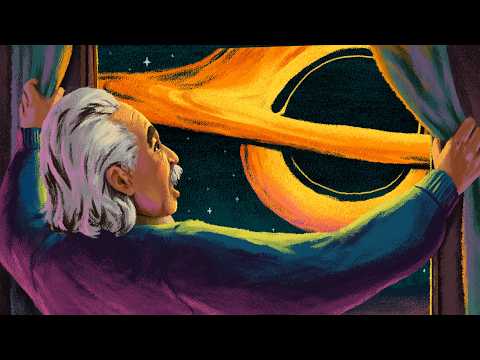
Nel 2019 la collaborazione internazionale Event Horizon Telescope pubblicò la prima immagine “in ombra” di un buco nero, quello al centro della galassia M87 (Event Horizon Telescope Collaboration 2019): massa masse solari, m. Nel 2022 arrivò un’immagine analoga di Sagittarius A*, al centro della Via Lattea (massa masse solari, m). I buchi neri stellari, formati dal collasso di una stella di massa maggiore di circa masse solari, hanno km; quelli supermassicci nei centri galattici vanno da a masse solari.
Collegamenti
Argomenti: Relatività ristretta Concetti: Invariante spazio-temporale · Legge di gravitazione universale
Esercizi collegati: Tipo spazio o tipo tempo · Problema — Particella o fotone · Il signor Rossi va a teatro
Solving Einstein’s equations in the simplest possible case — the vacuum outside a static spherical source of mass — Karl Schwarzschild found in 1916, just weeks before his death at the front, the so-called Schwarzschild metric. Without writing the metric tensor in full tensorial form, the effect on the spacetime “distance” (the Minkowski invariant) between two nearby events can be summarised as:
where is the distance from the centre of the mass, encodes the angular variations, and is the Schwarzschild radius.
Schwarzschild radius
For a mass the Schwarzschild radius is It is the characteristic scale of the gravitational metric produced by . For the Sun it is about km; for the Earth about mm; for the mass of a human being ( kg) about m, infinitesimal compared with the diameter of an atom.
For the metric returns to flat, indistinguishable from that of Minkowski: the corrections of general relativity become noticeable only near very massive and compact objects. At large distances the formula reproduces gravitational time dilation: a clock at rest at distance measures a proper time The closer one gets to the mass, the more decreases, and the more shortens relative to (the time read by an observer at infinity): the clock slows down.
Schwarzschild radius of the Sun and of the Earth
With kg and kg: To become a black hole, the Sun would have to collapse into a sphere of about km radius; the Earth into one of about mm.
Black holes
What happens to an object so compact that its effective radius is smaller than ? The metric becomes singular: the factor changes sign, and time and space “swap” roles. The surface is called the event horizon: anyone crossing it while descending towards the centre can no longer turn back, because all light cones now point towards . This is what we call a black hole.
Black hole (operational definition)
A black hole is an object whose mass is concentrated within a region of radius smaller than the Schwarzschild radius . The surface is called the event horizon: nothing, not even light, can escape from it.
To an external observer, an object falling into a black hole appears to slow down as it approaches (its clock runs ever more slowly), and at the same time the light reaching us from it shifts ever further into the red, until it fades out entirely. For the infalling object, however, crossing is a perfectly ordinary event: locally, at the horizon, nothing special happens. This is one of the most peculiar asymmetries in general relativity.
Real black holes
In 2019 the international Event Horizon Telescope collaboration published the first “shadow” image of a black hole, the one at the centre of the galaxy M87 (Event Horizon Telescope Collaboration 2019): mass solar masses, m. In 2022 a similar image arrived of Sagittarius A*, at the centre of the Milky Way (mass solar masses, m). Stellar black holes, formed from the collapse of a star of more than about solar masses, have km; the supermassive ones at galactic centres range from to solar masses.
Links
Topics: Special Relativity Concepts: Spacetime interval · Law of universal gravitation
Related exercises: Spacelike or timelike · Problem — Particle or photon · Mr Rossi goes to the theatre
Una previsione della relatività generale ha richiesto un secolo per essere verificata: le onde gravitazionali, increspature della metrica dello spazio-tempo che si propagano alla velocità della luce, generate da masse in moto accelerato — in particolare da sistemi binari di buchi neri o di stelle di neutroni che spiraleggiano l’uno verso l’altro fino alla fusione.
La prima rivelazione diretta è del 14 settembre 2015, ottenuta dall’interferometro LIGO con i suoi due rivelatori (a Hanford e a Livingston). L’evento GW150914 (Abbott et al. 2016) corrisponde alla fusione di due buchi neri di circa masse solari ciascuno, avvenuta a circa miliardi di anni luce da noi. La deformazione relativa dello spazio-tempo misurata è dell’ordine di : su una distanza di km (la lunghezza delle braccia dell’interferometro), significa uno spostamento m, circa un millesimo del diametro di un protone. La precisione richiesta sembra miracolosa, e infatti il premio Nobel 2017 fu assegnato a Weiss, Barish e Thorne per averla raggiunta.
Relatività generale in tre risultati chiave da ricordare
- il tempo rallenta in profondità gravitazionali (Pound-Rebka, GPS);
- sotto si formano buchi neri (M87, Sgr A*);
- lo spazio-tempo si propaga a tramite onde (LIGO 2015).

Collegamenti
Argomenti: Relatività ristretta Concetti: Legge di gravitazione universale
Esercizi collegati: Orbita LEO · Stima della massa della Galassia · Perché la Luna non cade
One prediction of general relativity took a century to be verified: gravitational waves, ripples in the spacetime metric that propagate at the speed of light, generated by masses undergoing accelerated motion — in particular by binary systems of black holes or neutron stars spiralling towards each other until they merge.
The first direct detection was on 14 September 2015, obtained by the LIGO interferometer with its two detectors (at Hanford and at Livingston). The event GW150914 (Abbott et al. 2016) corresponds to the merger of two black holes of about solar masses each, which occurred about billion light-years from us. The relative deformation of spacetime measured is of order : over a distance of km (the length of the interferometer’s arms), this means a displacement m, about a thousandth of the diameter of a proton. The precision required seems miraculous, and indeed the 2017 Nobel Prize was awarded to Weiss, Barish and Thorne for achieving it.
General relativity in three key results to remember
- time slows down in gravitational depths (Pound–Rebka, GPS);
- below black holes form (M87, Sgr A*);
- spacetime propagates at via waves (LIGO 2015).
Links
Topics: Special Relativity Concepts: Law of universal gravitation
Related exercises: LEO orbit · Estimate of the Galaxy’s mass · Why the Moon does not fall